
How to Import Products from China to Europe in 2026: The Complete Guide

Import products from China to Europe the right way with this step-by-step guide, from choosing a supplier to clearing customs.
Importing products from China can cut your purchasing costs dramatically — but only if you avoid the usual traps: the wrong supplier, poor quality, underestimated customs charges, and endless delays. This guide walks you through how to import into Europe safely in 2026.
1. Find the right supplier in China
Most importers start on Alibaba or 1688. That’s a fine starting point, but a listed price is not a reliable supplier. Always check:
- the manufacturer’s track record and verified reviews;
- whether they will provide samples before a bulk order;
- export certificates (CE, REACH) required to clear customs in the EU.
Working with a sourcing agent on the ground saves you from negotiating blind and separates real factories from resellers.
2. Inspect quality before shipping
Never pay the balance of an order without a quality check. A pre-shipment inspection (on-site check, photos, functional tests) is cheap insurance against receiving a container of unsellable goods — the step beginners skip most often.
3. Choose the right shipping method
Three options depending on budget and timeline:
- Express (DHL/FedEx): 3–7 days, ideal for samples and small quantities.
- Air freight: 5–10 days, a good middle ground for medium volumes.
- Sea freight: 30–45 days, the cheapest per kilo for large volumes.
4. Plan for customs and VAT
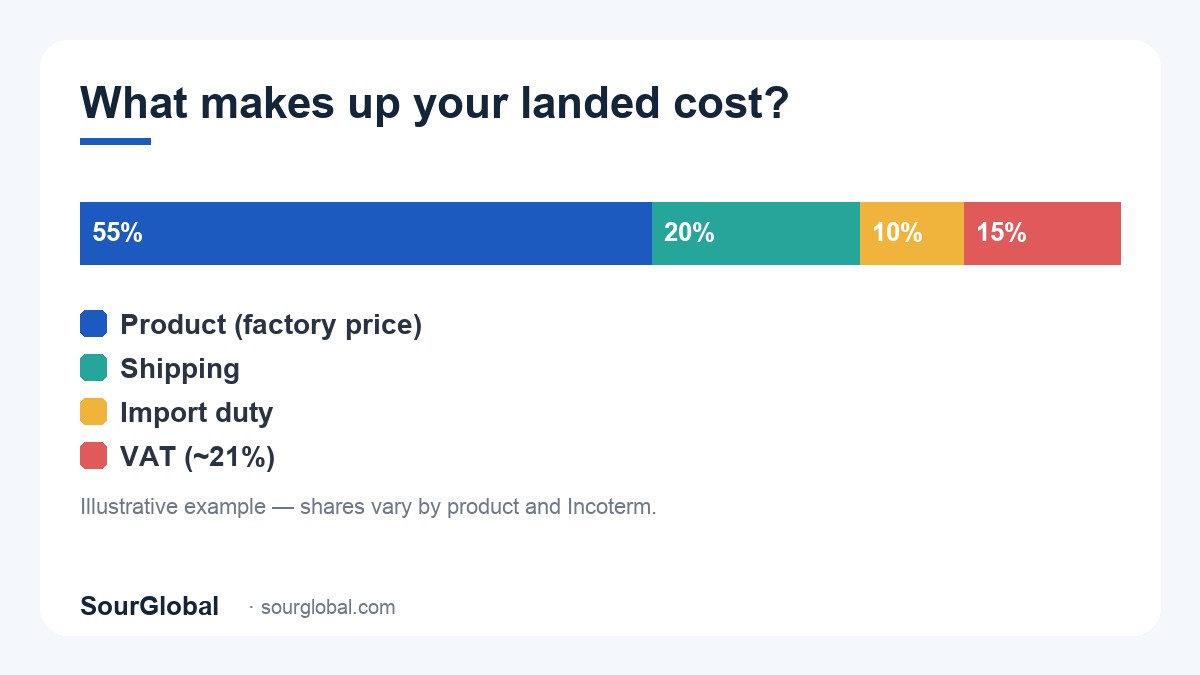
On arrival in the EU, your goods are subject to import duty (based on the product’s HS code) and VAT (typically 20–21% depending on the country). Build these into your landed cost from the start — many importers forget them and watch their margin disappear. A complete import file (commercial invoice, packing list, certificates) speeds up clearance.
5. Your real landed cost
Your final cost is not the factory price. Add up: product + inspection + shipping + duty + VAT + any agent fees. That number decides your margin — not the price shown on Alibaba.
FAQ
What does it cost to import products from China to Europe?
Import duty (based on the HS code), VAT (typically 20–21%), and shipping. Build all three into your landed cost from the start.
How long does shipping from China take?
Express 3–7 days, air freight 5–10 days, sea freight 30–45 days depending on volume.
Do I need an EORI number to import into the EU?
Yes. An EORI number is required to clear goods through customs anywhere in the EU.
Make the whole process simple
At SourGlobal we handle the entire chain — supplier sourcing, quality control, consolidation, and door-to-door delivery across Europe — and give you one all-in final price with no surprises. You focus on selling; we handle China.
Have a specific product in mind? Request a free quote and get an all-in delivered price within 48 hours.
A simple checklist to import products from China to Europe
Before you commit, run through a short checklist. Define the product and its required certifications (CE, REACH). Get quotes at several quantity tiers and pick your Incoterm — FOB to control freight, DDP for an all-in delivered price. Order a sample and inspect it. Confirm your EORI number and the product’s HS code so customs clearance is smooth. Budget the full landed cost: product, inspection, shipping, duty and VAT. Finally, plan lead time realistically across sampling, production and transport. Following this checklist to import products from China to Europe turns a risky first order into a repeatable, profitable process — and keeps your margin protected from hidden costs.
Further reading
Sea freight vs air freight
Your choice of transport shapes both cost and cash flow. Sea freight is by far the cheapest per kilo and suits bulky or heavy orders, but it takes 30–45 days and ties up capital while goods are in transit. Air freight lands in 5–10 days at a higher price, which works well for lighter, higher-margin products or urgent restocks. Many importers use a hybrid approach: air-ship a small first batch to start selling quickly, then move the bulk by sea. Factor the transit time into your inventory planning so you never run out of stock, and always confirm whether the quote includes destination charges and delivery.